
 Illinois
 IRS
IRSHome / Water
 Water service
Your lead service line inventory and replacement plan, ready before November 1, 2027.
Under EPA's Lead and Copper Rule Improvements, every community water system, and every school, plant or other site that runs its own regulated water system, owes the state a baseline inventory of every service line by November 1, 2027. If any line is lead, galvanized requiring replacement or unknown, a service line replacement plan is due the same day. We build both from the records you already have, for a fixed price.
For systems serving 10,000 people or fewer. Send your PWSID, or your system name and state. Your certified operator or responsible official signs and submits.
Small systems in EPA's records
active community water systems serve 10,000 people or fewer.
of their service lines are still listed as lead status unknown: 21.8% of the lines they reported.
of those systems report at least one lead, galvanized or unknown line, the condition that requires a replacement plan.
still show an open violation for the 2024 initial inventory (EPA violation code 2E).
Our counts from EPA's Safe Drinking Water Information System, pulled October 13, 2026. State by state, with the method. In 2024, 3,902 public water systems had a health-based violation for missing the October 16, 2024 initial inventory (EPA National Public Water Systems Compliance Report, 2024).
The rule
What the rule asks of your system
EPA published the Lead and Copper Rule Improvements on October 30, 2024 (89 FR 86418), and the rule took effect December 30, 2024. Most of its duties start November 1, 2027. Here is the short version for a small system, with the rule text under each point.
Send the state a baseline inventory
List every service line, whoever owns it. Where you and the customer each own part of a line, list both parts. List the connectors too, and give every line a street address or, failing that, a block, GPS point, intersection or landmark. Due November 1, 2027.
40 CFR 141.84(a)(2) and (a)(4)
Put each line in one of four categories
Lead, galvanized requiring replacement, non-lead, or lead status unknown, and write down the evidence for each. The categories are explained below.
40 CFR 141.84(a)(3)
Write a replacement plan if any line is lead, galvanized or unknown
The plan says how you will identify unknown lines, how you will replace lines and in what order, how you will pay, how you will tell customers, how people should flush after work on a line, and which local laws affect getting onto private property. Due with the inventory.
40 CFR 141.84(c)
Tell the people on those lines
Every home or building on a lead, galvanized requiring replacement or unknown line gets a notice within 30 days of the baseline inventory, then again after each yearly update until the line is replaced or shown to be non-lead. Under the 2021 rule, yearly notices already apply today.
40 CFR 141.85(e)
Keep it open to the public
The inventory and the plan must be publicly accessible. Systems serving more than 50,000 people must post them online; smaller systems can keep a copy at the office or send it by mail, and the Consumer Confidence Report must say how to find the inventory.
40 CFR 141.84(a)(5) and (c)(2)
Update it every year
Send the state an updated inventory, and an updated plan or a statement that nothing changed, by January 30 each year, starting January 30, 2029. Record pipe materials whenever your crew sees them during normal work.
40 CFR 141.90(e)(3) and (e)(4); 141.84(b)(2)(v)
Replace lead and galvanized lines within 10 years
Replacement programs start November 1, 2027. Lead and galvanized requiring replacement lines under your control must be replaced within 10 years, unless your state sets a different deadline, and every unknown line must be identified by then.
40 CFR 141.84(b)(1)(i) and (d)(4)
Check a sample of your non-lead lines
By December 31, 2034 for most systems, inspect a random sample of lines marked non-lead at two points. Lines with records showing installation after the lead ban, lines already inspected at two points and lines that replaced lead are left out of the pool.
40 CFR 141.84(b)(5)
| Date | What happens | Rule |
|---|---|---|
| Oct. 16, 2024 | Initial inventory due under the 2021 rule. Yearly notices to people on lead, galvanized or unknown lines start. | 141.84(a)(1), 141.85(e) |
| Dec. 30, 2024 | The 2024 rule takes effect. | 89 FR 86418 |
| Sept. 30, 2026 | A federal appeals court hears a challenge to the 2024 rule. No ruling as of October 13, 2026. | D.C. Cir. No. 24-1376 |
| Nov. 1, 2027 | Baseline inventory and replacement plan due. Replacement program starts. | 141.80(a)(3), 141.84 |
| 30 days later | Notice to every address on a lead, galvanized requiring replacement or unknown line. | 141.85(e)(2) |
| Jan. 30, 2029 | First yearly inventory and plan update, then every January 30. | 141.90(e)(3), (e)(4) |
| Dec. 31, 2034 | Spot check of a random sample of non-lead lines done, for most systems. | 141.84(b)(5) |
| 2037 | Replacement deadline for most systems, 10 years after November 1, 2027. | 141.84(d)(4) |
Every line goes in one of four categories
Where ownership is split, each part of the line gets its own category.
Lead
Any part of the line is lead. Lead-lined galvanized pipe counts as lead.
ReplaceGalvanized requiring replacement
Galvanized pipe that is, or ever was, downstream of a lead line, or is now downstream of an unknown line. If you cannot show it was never downstream of lead, it counts.
ReplaceNon-lead
Records, a method or an inspection show it is not lead and not galvanized requiring replacement. You do not have to name the exact material.
No actionLead status unknown
No reliable evidence either way. Each unknown line gets a yearly notice and must be identified by your replacement deadline.
Identify40 CFR 141.84(a)(3) and the definitions in 40 CFR 141.2. The service line runs from the water main to the building inlet. The connector, often called a gooseneck or pigtail, is a short bendable piece of up to three feet, listed separately as lead, non-lead, unknown or no connector present.
About the court case
The American Water Works Association has challenged the 2024 rule in the U.S. Court of Appeals for the D.C. Circuit (American Water Works Association v. EPA, No. 24-1376). The court heard argument on September 30, 2026 and, as of October 13, 2026, had not ruled. EPA is defending the rule. The challenge is aimed mainly at the replacement requirements. The duty to keep a service line inventory also exists under the 2021 rule, in force since October 16, 2024, so inventory work is needed either way. If a ruling changes what the inventory or plan must contain before we deliver, we update them at no extra charge.
The first deadline was enforced
In 2024, 3,902 public water systems, about 2.7 percent of active systems, had a health-based violation because they did not meet the October 16, 2024 initial inventory requirement. In EPA's records today, 4,574 community systems serving 10,000 or fewer carry that violation and 1,544 are still listed as in violation. Your state handles enforcement in most cases; EPA does so directly in Wyoming, the District of Columbia and most of Indian country.
Official sources: 40 CFR part 141, subpart I (eCFR); final rule, 89 FR 86418; EPA: Lead and Copper Rule Improvements; EPA: 2021 Lead and Copper Rule Revisions. Checked October 13, 2026.
What you get
The Inventory and Replacement Plan Kit
Built from the records you already have, set up the way your state asks for it, and ready for your certified operator or responsible official to review, sign and send.
Baseline inventory in your state's template
Your tap cards, permits, meter and billing records, maps, construction dates and plumbing code dates turned into a line-by-line inventory, in the format your state wants, with a street address for every line.
Every line and connector classified
Each line, and each side where ownership is split, placed in the rule's four categories, plus a category for each connector. The record behind every call is written beside it, so you can answer the state's questions.
Unknown lines, sorted by the cheapest fix
Every line still unknown, grouped by what it will take to settle: another record, a look in the meter pit or curb box during a routine read, a customer photo where your state accepts it, or field work as a last resort.
Service line replacement plan, drafted
Every part 40 CFR 141.84(c) lists, in order, with your priorities, funding sources such as State Revolving Fund lead money, customer communications, flushing and access to private property.
Customer notice letters
Letters for homes and buildings on lead, galvanized requiring replacement and unknown lines, with the content the rule requires, ready for your system to send.
Totals, public table and filing notes
The counts the state asks for under 40 CFR 141.90(e)(2), a plain public version of the inventory you can post or hand out, and notes for whoever submits.
What the replacement plan covers
- How you will identify unknown lines
- Your procedure for full service line replacement
- How you tell people before a replacement
- How people flush after a disturbance or replacement
- How you set replacement priorities
- How you will pay, including help for owners who cannot pay their part
- How you tell everyone about the plan and the program
- Laws, rules and tariffs that affect access to private property
- Lead-lined galvanized lines, if you have any
40 CFR 141.84(c)(1)
Checked before it reaches you
An experienced water-industry reviewer checks every kit before delivery. It is a practical check by someone who knows service line records, not an engineer's seal. Your certified operator or responsible official then reviews, signs and submits.
Not included
- Field verification: no potholing, excavation or site visits. Your crew or a local contractor does any field work.
- An engineer's stamp or engineering design. Where your state requires an engineer to prepare or seal any part of the plan, your engineer does that part and we work alongside them.
- Legal advice, and submitting to or speaking with the state.
We classify lines from records using the rule's own categories and give no engineering opinion. Your state makes the final call on your inventory and plan.
Look inside the kit
The opening pages of three core documents
Drafted from the rule text. In your kit, each one is completed from your records.
Inventory layout
Service line and connector inventory
28 columns, each tied to the rule. The opening columns:
| Column | Rule |
|---|---|
street_address | 141.84(a)(4) |
system_side_category | 141.84(a)(3) |
customer_side_category | 141.84(a)(3) |
full_line_category | 141.90(e)(2)(vii) |
connector_category | 141.84(a)(2)(ii) |
installed_after_lead_ban | 141.84(b)(5)(i) |
Then the evidence behind each call, the validation pool, building type, replacement date and type, last notice sent and last updated.
Replacement plan
Service line replacement plan
Section 1.1 Where we start. Our baseline inventory, submitted to [STATE AGENCY] on [DATE], lists [N] service lines. Of these, [U] are lead status unknown.
The rule requires us to identify the material of every unknown service line by our mandatory replacement deadline. Until a line is identified, the people it serves receive a notice every year.
Section 1.2 How we will identify unknown lines: records first, then routine meter work, then customer help where the state accepts it, then field checks.
Customer notice
Important information about the water service line at [SERVICE ADDRESS]
We are writing because our records do not show what your water service line is made of. The material of your service line is unknown, but it may be lead.
Health effects of lead. There is no safe level of lead in drinking water. Exposure to lead in drinking water can cause serious health effects in all age groups, especially pregnant people, infants (both formula-fed and breastfed) and young children.
Grants and loans
Federal lead money can pay for the inventory and plan, not only for digging.
EPA says service line inventories are eligible for State Revolving Fund lead service line money "regardless of whether lead service lines are found during the inventory" (IIJA SRF Questions and Answers, question 9.13). Each state runs its own program. Here is what we found for six states with the most systems on our list, as published on each program's page and checked October 13, 2026.
North Carolina
NC DEQ, DWSRF lead service line funding
- Developing or updating lead service line inventories is listed as eligible.
- Per the FY2025 Intended Use Plan, at least half the fund is reserved for inventory projects, with no engineering report needed for them.
- 25% to 100% principal forgiveness for disadvantaged systems.
- Rolling applications. Next cut-off November 2, 2026, awards December 9. 2027 cut-offs not yet posted.
Washington
WA Department of Health, DWSRF lead service line loan
- Eligible work includes records review, site inspections and potholing.
- 49% principal forgiveness for disadvantaged communities only; others get a standard loan.
- The Department calls this the final cycle of this federal money.
- Applications due November 30, 2026.
Iowa
Iowa DNR and Iowa Finance Authority, SRF lead service line fund
- The SFY2027 plan says forgiveness may be issued for lead service line inventory or replacement, capped at 49% per project for disadvantaged communities.
- Applications normally go in with a Preliminary Engineering Report; ask the SRF coordinator whether an inventory-only project needs one.
- Next application deadline December 1, 2026.
Missouri
Missouri DNR, DWSRF lead service line grant and loan
- Inventory: 100% grant if disadvantaged, otherwise up to US$102,500 forgiven.
- Plan: 100% grant up to US$50,000 if disadvantaged, otherwise up to US$20,500.
- Inventory applications get priority. A governing body resolution goes with the application. Work started before DNR's notice is not eligible.
- Open to December 31, 2026, first come, first served.
Georgia
GEFA Lead Service Line Replacement Program, 2027 call for projects
- Covers inventory and replacement plan work, with principal forgiveness set by affordability.
- The borrower must be a public entity, and only projects on the Intended Use Plan are funded.
- Money may arrive after November 1, 2027, so plan your own timing.
- Pre-applications due 5:00 p.m. January 29, 2027.
Illinois
Illinois EPA Lead Service Line Inventory grant, Round 4
- US$20,000 to US$50,000 per local government, for the inventory only, not the plan.
- For local governments with median household income under 120% of the state average, prequalified under the state's grant rules.
- First come, first served, open until the money runs out. Illinois EPA's plan says the pot is almost spent, so call the program first.
- Costs before the grant is signed are not eligible.
Federal programs behind the state money
| Program | What it offers | Who can use it | When |
|---|---|---|---|
| Drinking Water State Revolving Fund, lead service line moneyEPA, through each state | US$15 billion under the Infrastructure Investment and Jobs Act; 49% goes out as grants or principal forgiveness, with no state match. Identification, planning, design and replacement are eligible. In November 2025 EPA announced a further US$3 billion, plus US$1.1 billion of unused lead money redistributed. | Publicly and privately owned community water systems, and nonprofit non-community systems | Each state's own window (above) |
| DWSRF set-asidesEPA, through each state | States can use set-aside funds, which are not repaid, for inventories and lead-related technical help. | Any community water system, as the state decides | Varies by state |
| SmaRT grantEPA, formerly Small, Underserved and Disadvantaged Communities | US$25 million allotted for fiscal 2026, by formula to states, noncompetitive. Lead service line inventories and replacement are eligible. | Communities under 10,000 people that cannot take on debt, or disadvantaged under state criteria; apply to your state | States apply on a rolling basis |
| Reducing Lead in Drinking Water grantEPA, WIIN Act section 2105 | Over US$35 million awarded January 20, 2026; 20% non-federal match; inventories are eligible. | Community and non-transient systems, municipalities, qualified nonprofits | Competitive; no open notice found as of October 13, 2026 |
| Water and Waste Disposal Loan and GrantUSDA Rural Development | Loans and grants; EPA's funding guide lists lead service line inventories as an eligible cost. | Rural areas and towns of 10,000 or fewer that cannot get commercial credit | Year round |
| Predevelopment Planning GrantUSDA Rural Development | Up to 75% of planning costs. | Low-income rural towns of 10,000 or fewer | Ongoing |
Sources: EPA, Identifying Federal Funding Sources for Lead Service Line Replacement; EPA, IIJA SRF Questions and Answers, October 2025 (PDF); EPA SmaRT grant; EPA WIIN Reducing Lead in Drinking Water; USDA Water and Waste Disposal; USDA Predevelopment Planning Grants. Checked October 13, 2026.
Apply before you sign
Some programs refuse costs incurred before the award. Missouri does not pay for work started before DNR's notice, and Illinois does not pay for costs before the grant is signed. If you plan to use state money, apply first. Our one-page quote and scope can go into the application, and we start the day you tell us the money is in place.
The purchasing rules come with the money
EPA says State Revolving Fund loans, with or without principal forgiveness, follow state and local purchasing rules, while SRF grants are federal subawards that follow 2 CFR 200.317 to 200.327. Under those federal rules, a purchase up to the micro-purchase threshold, US$15,000 for awards made after October 1, 2025, needs no competing quotes if the price is reasonable. A stricter state or local rule wins, so ask your SRF office.
Read more: paying for the inventory and plan with State Revolving Fund lead money. This section describes public program rules; it is not legal or financial advice, and each state decides what it funds.
Sample snapshots
Real snapshots, built from EPA's public record
Three of the free one-page snapshots we prepared on October 13, 2026, with each system's name, PWSID and town removed. Every figure is real and comes from EPA's records. Yours looks the same, built from your own record.
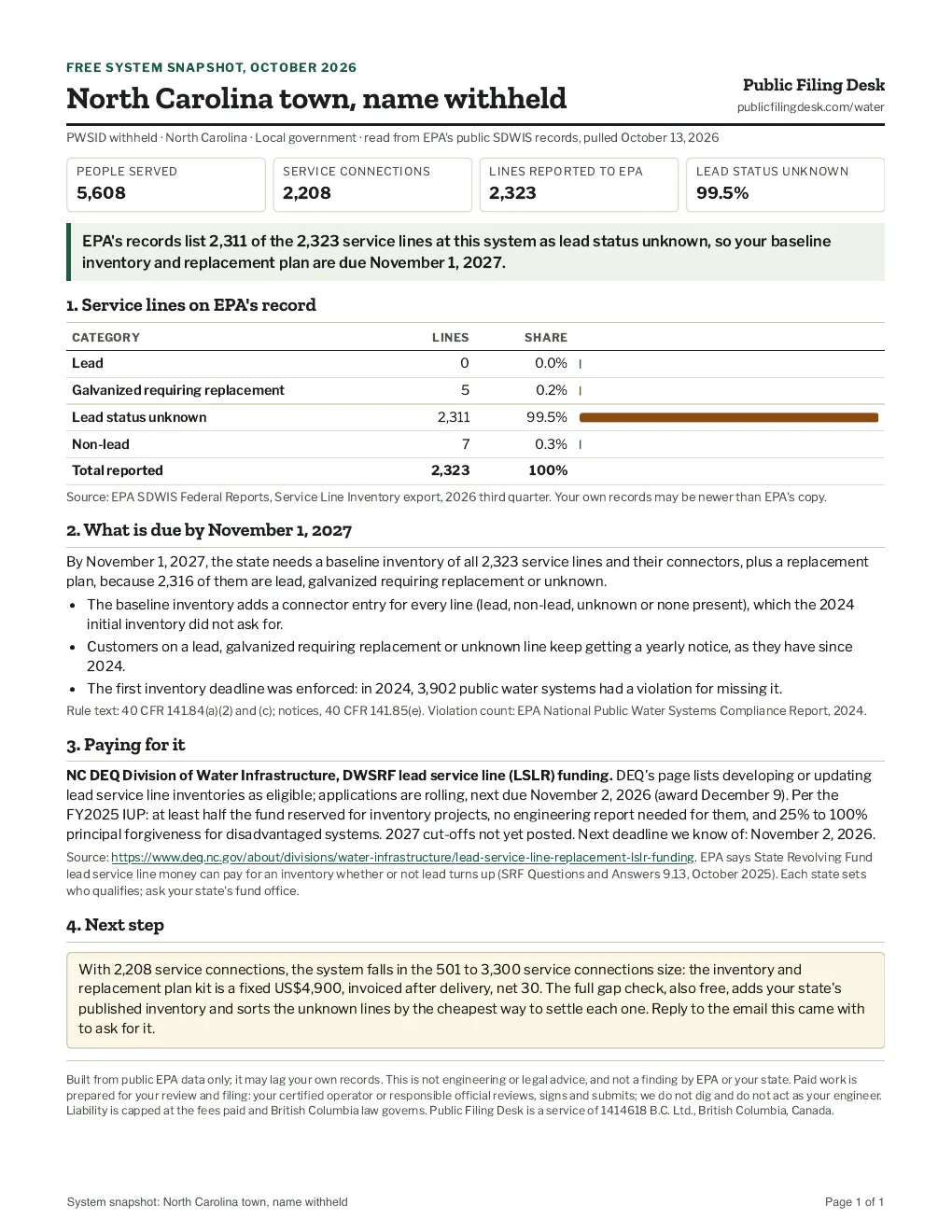
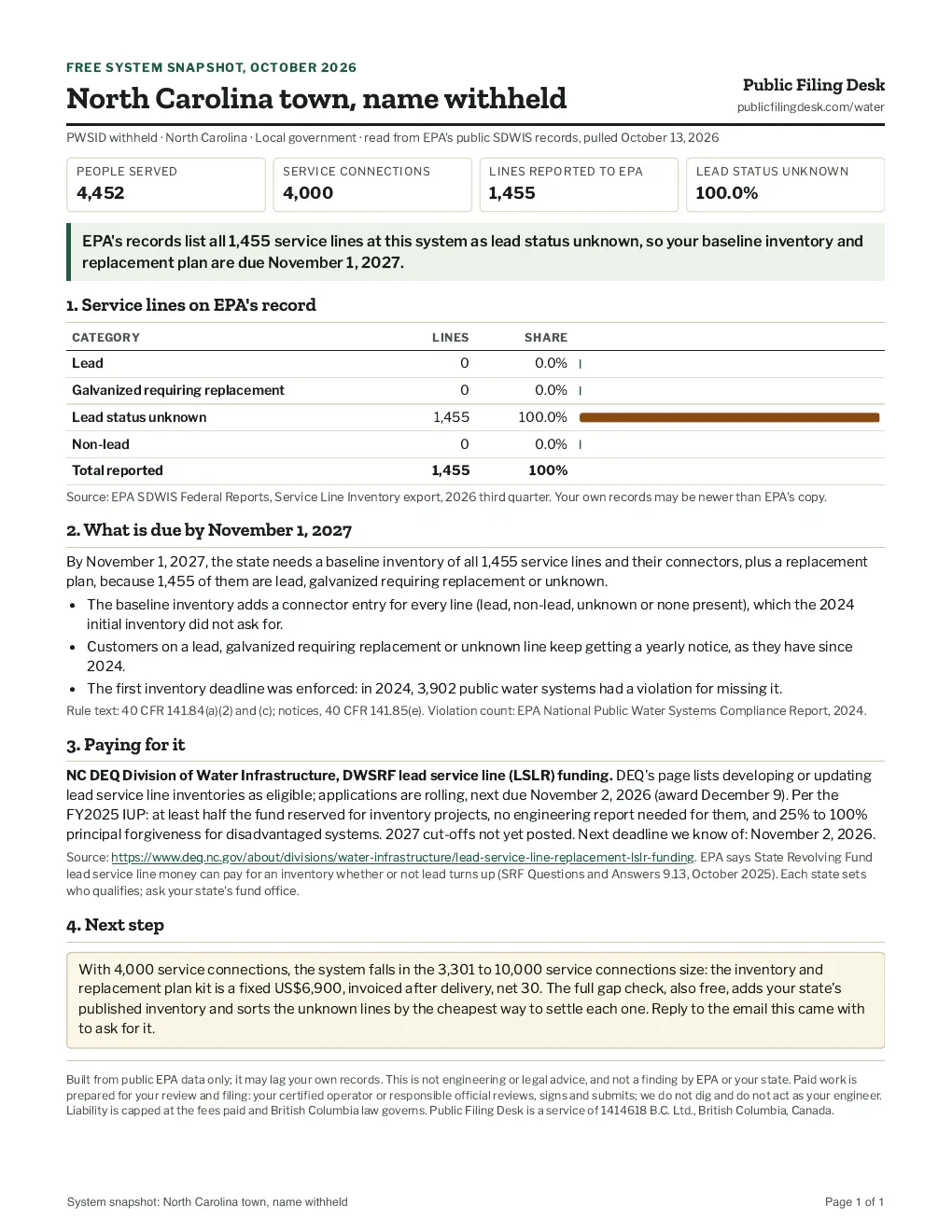
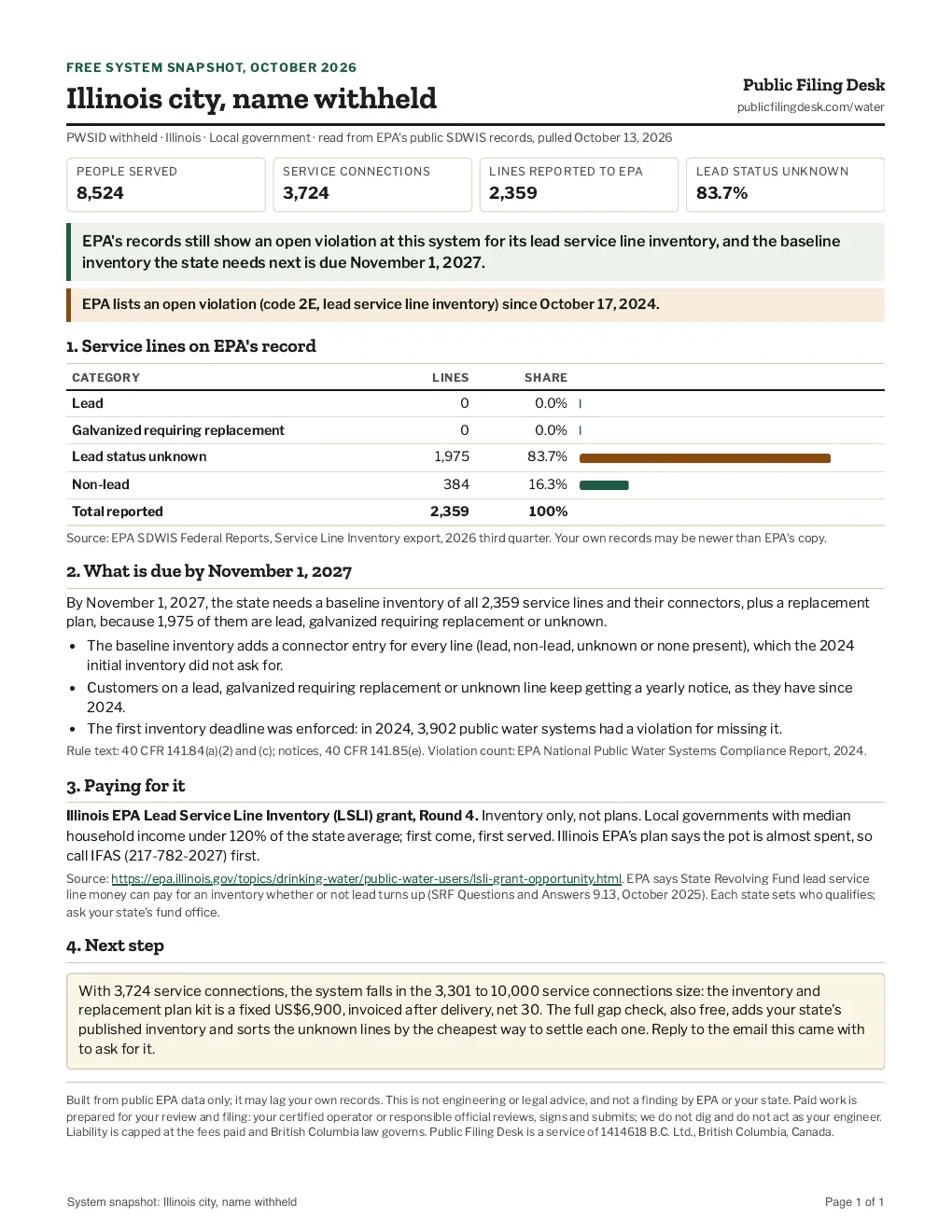
The full gap check, also free
Ask for it and we add your state's published inventory, list what the 2027 baseline needs that your 2024 inventory lacks (connectors, both sides of split lines, addresses), and sort your unknown lines by the cheapest way to settle each. It is built from public records only, and it is not an engineering review or a finding by any agency.
What we need from you
Whatever records you have, in any form
Scans and phone photos are fine. Gaps are normal: we work from what exists and list what is missing, with the simplest way to fill it.
What we never ask for
Logins to the state portal, SDWIS, your billing system or your bank, or customers' payment details. Service addresses are enough; we do not need customers' names.
- Your PWSID (two letters and seven digits), system name and state.
- Your certified operator or responsible official: name, email and phone. They sign and submit.
- Your count of service connections, from your own records.
- Your initial inventory as submitted in 2024, and anything the state said about it.
- Tap cards, service and plumbing permits, meter install and change-out records, billing records with service addresses, distribution maps and as-builts, work orders, inspections and pipe photos.
- The years homes and subdivisions were built, and the date your town or state banned lead pipe.
- Replacements or repairs done since 2024.
- Your state's inventory template, if it sent you one. We find it otherwise.
- Whether you have, or are applying for, State Revolving Fund lead money, and your engineer's name if your state wants one on the plan.
Timeline
From first email to the state, step by step
Most of the time goes into pulling records together on your side. Starting by spring 2027 leaves room for state questions and any field checks before November 1, 2027.
Free snapshot
Within 2 business daysEmail your PWSID or system name. You get the one-page snapshot, and the full gap check if you ask for it.
Quote and scope
On requestA one-page fixed quote with the scope and a delivery date, addressed to your board or your funding program. If you use state money, apply first.
You send records
Your paceWhatever you have, by email. We ask follow-up questions in writing and tell you early if a gap will leave lines unknown.
We build the kit
A few weeks for a small systemInventory, categories, unknown-line sort, plan draft, notices and public table. Larger systems take longer; the date in the quote is the date we hold.
Review and delivery
Before deliveryAn experienced water-industry reviewer checks the kit. You get it with filing notes and a list of anything your records could not settle. You have 10 business days to tell us anything to correct, at no charge.
Your operator signs and submits
By November 1, 2027Your certified operator or responsible official sends the inventory and plan to the state, then the notices go out within 30 days. We invoice, net 30.
Every year after
By each January 30, from 2029If you want it, our annual update adds what you learned during the year and prepares the updated inventory for your filing.
Pricing
One fixed price, set by the size of your system
| Service connections | Fixed price |
|---|---|
| Up to 500 | US$2,900 |
| 501 to 3,300 | US$4,900 |
| 3,301 to 10,000 | US$6,900 |
The free snapshot shows your connection count from your EPA record and which price applies. If your own count differs, we use yours.
Annual inventory update, from US$900 a year
We add what you learned during the year from meter reads, repairs and replacements, and prepare the updated inventory for your January 30 filing with the state. Quoted in writing; cancel any year by email.
- Quote
- A fixed price, quoted in writing before any work starts, valid 30 days. A one-page quote and scope for your board packet or grant application.
- Payment
- No payment until the kit is delivered. Invoice net 30. No deposit.
- Methods
- ACH bank transfer or check, in US dollars. If your rules require a card, tell us before you order and we confirm whether we can take one.
- Tax form
- We are a Canadian corporation, so US payers get IRS Form W-8BEN-E, the form for foreign entities, instead of a W-9. About Form W-8BEN-E
- Included
- Everything listed under "What you get", the reviewer's check, and corrections you ask for within 10 business days of delivery.
- Not included
- Field verification, an engineer's stamp or design, legal advice, and submitting to or speaking with the state.
- If the state sends it back
- If your state returns the inventory or plan for a reason inside our work, we fix it free.
Questions
Questions operators and boards ask
We heard about a court case. Do we still have to do this?
Plan on it. The 2024 rule is in effect and its November 1, 2027 date has not changed. The court heard the challenge on September 30, 2026 and, as of October 13, 2026, had not ruled; EPA is defending the rule. The challenge is aimed mainly at the replacement requirements, and the inventory duty already applies under the 2021 rule, so inventory work is needed either way. If a ruling removes the need for the work before we start, either side can end the agreement and you get a full refund.
We did an inventory in 2024. Do we need this?
Most likely. The 2024 rule asks every system for a baseline inventory by November 1, 2027. It must list connectors, which the 2024 inventories did not have to include, a street address for every line, and anything you have learned since. If any line is lead, galvanized requiring replacement or unknown, you also need the replacement plan. If your 2024 inventory shows only non-lead lines and no lead or unknown connectors, you need much less, and the free snapshot will say so. We build on your 2024 inventory rather than starting over.
40 CFR 141.84(a)(2) and (a)(6)
What records do you need?
Whatever you have: tap cards, service and plumbing permits, meter install and change-out records, billing records with service addresses, distribution maps and as-builts, work orders, the years homes and subdivisions were built, and the date your town or state banned lead pipe. Scans and phone photos are fine.
Do you dig or send a crew?
No. This is records work. We do not pothole, excavate or visit. For each line the records cannot settle, we list the cheapest way to find out, such as a look in the meter pit or curb box during a routine read, a customer photo where your state accepts it, or potholing as a last resort. Your crew or a local contractor does any field work.
Who signs and submits? Do we need an engineer?
Your system does. Your certified operator or responsible official reviews, signs and sends everything to the state, and your system sends the customer notices. The federal rule does not require an engineer for the inventory. If your state wants an engineer to prepare or seal any part of the plan, your engineer does that part and we work alongside them. We do not act as your engineer and we give no legal advice.
Who checks the kit?
An experienced water-industry reviewer checks every kit before delivery. It is a practical check by someone who knows service line records, not an engineer's seal. Then your operator reviews it. If anything is wrong or missing, tell us within 10 business days of delivery and we correct it at no charge.
Can grant or loan money pay for this?
Often it can. EPA says lead service line money from the Drinking Water State Revolving Fund can pay for an inventory whether or not lead turns up, and for planning. Each state decides who it pays and for what, and some refuse costs incurred before the award, so ask your state's fund office first. See grants by state above.
How long does it take?
Most of the time goes into pulling records together on your end. Once we have them, plan on a few weeks for a small system and longer for a larger one. We put a delivery date in the quote, and that is the date we hold.
What if most of our lines are unknown?
That is common where records are old. Unknown is an allowed category, but every unknown line needs a yearly notice, means you need a replacement plan, and must be identified by your replacement deadline. So it pays to shrink the list early. We sort your unknowns by the cheapest way to settle them, and the plan sets out your strategy for the rest, as the rule requires.
40 CFR 141.84(b)(1)(i) and (c)(1)(i)
We are a private system, a school or a mobile home park. Is this for us?
Yes, if you are a community water system or a non-transient non-community system, such as a school or workplace with its own water, serving 10,000 people or fewer. Payment is the same: invoice after delivery, net 30. For funding, EPA says the revolving fund can help publicly and privately owned community systems and nonprofit non-community systems; a for-profit business running its own non-community system is not on that list.
Questions about all three services: payment, data handling, our W-8BEN-E and more
Insights
Short reads to forward to your board
Settling unknown service lines from records, before anyone digs
The records the rule names, the lead ban dates that matter, and why field work comes last.
Read the noteFrom the 2024 initial inventory to the 2027 baseline inventory
Connectors, street addresses, new totals and yearly updates: what changes, line by line.
Read the notePaying for the inventory and plan with State Revolving Fund lead money
What EPA says is eligible, who can borrow, the purchasing rules that come with the money, and five questions for your state.
Read the noteSmall-system snapshot, October 2026
Every state's count of small systems, unknown lines and open inventory violations, from EPA's records, with the method and a CSV download.
See the snapshot Free download, PDFNovember 2027 checklist for small water systems
Two pages: key dates, what to gather, what goes in the inventory and the plan, and what repeats every year. Every item cites the rule. No sign-up.
Download the checklistSee where your system stands, well before November 1, 2027.
Send your PWSID, or your system name and state. Within 2 business days you get a one-page snapshot from your EPA record, like the samples above. Ask for the full gap check and we add your state's published inventory and sort your unknown lines by the cheapest way to settle each. Both are free.
Already have our email? Just reply "yes" to it.